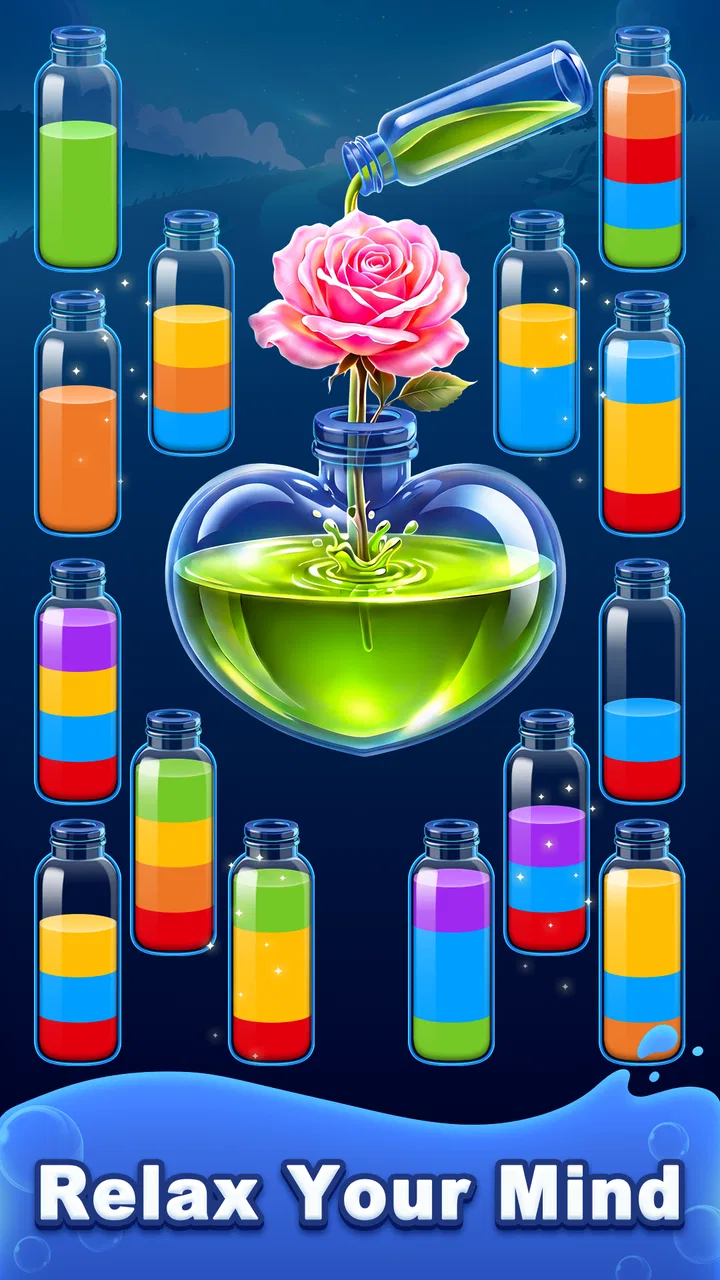
Water Sort! Color Sort Puzzle
- 4.9
- Rating
- 10.00M
- Installs
- Free
- Price

 Analysis by App-foxy
I expected a simple color-matching time filler, but Water Sort! Color Sort Puzzle works because its central action is immediately understandable: choose a bottle, pour its top color into another bottle, and try to finish with each bottle holding one color. That first move feels harmless, yet it can quietly decide whether the rest of the puzzle stays open or becomes a careful rescue job.
In my experience, that tension is the reason I kept starting another round. The game belongs to the puzzle category and comes from Bobodoo Game. It is free to download, aimed at Everyone, and designed to work offline, which makes it a natural choice for short breaks when I want something interactive rather than another stream of content.
The store summary presents it as a relaxing way to sort colors, and that is broadly accurate, but relaxation depends on how I play. When I slow down and plan the available spaces, the game becomes pleasantly quiet. When I pour too quickly, I create a blocked board and have to rethink the entire arrangement. That contrast gives the app more substance than its very small rule set suggests.
You May Also Like

 Blood Strike: 2.5 Anniversary
Blood Strike’s Loadouts Turn Every Drop Into a Tactical Gamble
A close look at Blood Strike’s custom loadouts: how fast access to signature weapons reshapes its battle royale rhythm, rewards preparation, and narrows the gap between fights.

 Pandora - Music & Podcasts
Pandora’s Music Is Easy to Start, but Harder to Recover
Pandora’s strength is its low-effort path from a seed to a station. Its weak spot is how much confidence it asks you to place in connection, setup, and quiet recovery.

 8 Ball Pool
 Is Built on Rivalries, Rematches, and Routine
A close look at the rivalries, rematches, shared routines, and unanswered safety questions that turn a quick pool match into a persistent mobile community.

 Samsung Music
’s Quiet Strength Is Playing What You Already Own
Its reach comes less from spectacle than from dependable access to a personal library. That simplicity is both the app’s strongest retention engine and its ceiling.

 AccuWeather: Weather Radar
AccuWeather Review: A Quick, Clear Forecast for Everyday Decisions
For everyday plans, the best forecast is the one you can understand quickly. AccuWeather makes rain timing, radar, and local conditions easy to act on, with a few trade-offs.

 Hill Climb Racing
Why Hill Climb Racing Still Turns Crashes Into One More Run
A tiny car, a bumpy hill and one more upgrade: Hill Climb Racing keeps resurfacing because its simple chaos makes every near-miss feel personal.
More From Our News Desk



One pour is enough to explain the game
The opening experience is strong because there is no complicated control system to learn. I tap a bottle, tap the destination, and watch the colored liquid move if the transfer is allowed. The visual result is clear: a bottle gains a matching layer, an empty space becomes useful, or a mistake reduces the room I have left to work.
That immediate feedback matters. A puzzle like this could feel abstract if the board did not show the consequences clearly, but the stacked colors make every decision visible. I can usually understand why a move worked without reading instructions, and I can also see why a move failed. The interaction is simple enough for casual players while still leaving room for deliberate planning.
The best early habit is to resist pouring merely because a move is available. I first look for colors that are already close to being grouped, then identify which bottle can serve as temporary storage. This is a more useful approach than chasing the most obvious matching pair. A matching pour may look productive, but it can also bury a color that I need to access later.
That is one of the first non-obvious lessons in this game: empty space is not wasted space. An open bottle is a planning tool. I try to preserve at least one flexible destination whenever the arrangement allows it, especially when several colors are stacked above one another. Filling every available gap too early often leaves no way to separate the next layer.
Why the controls feel satisfying
Each successful transfer gives a small sense of order. The board becomes easier to read, the matching layers sit together, and the number of possible decisions gradually shrinks. I do not need a large animation or elaborate reward system to understand that I am progressing; the arrangement itself supplies the feedback.
There is also a useful rhythm between action and inspection. I make a pour, watch the new stack, and pause to recalculate. That pause is important because the puzzle does not reward constant tapping. It rewards noticing which color is exposed and which bottle can safely receive it. Players who enjoy visual organization will probably appreciate this more than people looking for rapid reflex challenges.
The color-based design is approachable, though it may be less comfortable for someone who has difficulty distinguishing similar shades. Because the puzzle depends heavily on visual separation, I would recommend trying a few rounds before committing to long sessions if color recognition is a concern. The rules are straightforward, but the colors carry most of the information.
The feedback loop keeps the board readable
What I like most is how quickly the game tells me whether my thinking is helping. A correct pour creates a cleaner stack. A poor pour usually makes the next decision harder. I am not waiting for a long calculation or studying a complicated interface; the board responds immediately, so the connection between choice and consequence stays intact.
This creates a satisfying loop: I act, the liquid shifts, the color arrangement changes, and I reassess. When a sequence works, several layers can fall into place and the board suddenly looks much less intimidating. When a sequence fails, the problem is usually understandable. I can often trace the trouble back to the moment I used a bottle as storage without considering what had to come out afterward.
A practical technique is to think in pairs of moves rather than isolated taps. Before pouring a color into a bottle, I ask where the newly exposed color might go next. This prevents the common mistake of making a legal move that has no useful follow-up. It also helps distinguish progress from simple rearrangement.
Another helpful approach is to protect the top layer of a bottle unless exposing the layer beneath it serves a clear purpose. The top color is the only part I can move immediately, so covering it with another color can make the bottle less useful. I found that treating each top layer as an access point makes the puzzles feel more manageable without removing their challenge.
The game is at its most enjoyable when I am alert enough to plan but not so tired that every arrangement feels overwhelming. That makes it well suited to a short waiting period, a quiet break, or a few minutes before bed. It is less suitable when I want a story, a competitive ranking system, or a large variety of puzzle rules.
Completion feels like a small, clean reward
The reward in Water Sort! Color Sort Puzzle is mainly the finished board. Once the colors are organized, the visual clutter disappears and the result feels complete. I find that more satisfying than I expected because the game begins with disorder and ends with a clear, self-explanatory solution.
That reward is not based on collecting a complicated set of resources. It comes from understanding the arrangement. A difficult board can sit in an unsolved state for several minutes, then become obvious after one useful empty-space move. The pleasure comes from seeing the structure rather than from rushing through the controls.
For everyday use, this makes the game a good mental reset. If I have a few minutes between tasks, I can focus on one contained problem, finish it, and put the phone away with a definite sense of closure. It does not demand the long commitment of a strategy game, and it does not require sound or a stable connection to be enjoyable.
The offline design is especially practical here. I can use it in situations where online games are inconvenient, such as traveling, waiting in a place with unreliable service, or trying to reduce distractions. Offline play also suits the quiet nature of the puzzle: there is no need to coordinate with other people or keep up with a live event.
Still, the reward has limits. Players who need a strong narrative, character progression, or a clear competitive goal may find the completion screen too modest. The satisfaction is personal and momentary. I solve the board, enjoy the neat result, and then decide whether I want another arrangement. That simplicity is a strength for casual play, but it can feel thin for anyone seeking a deeper long-term system.
Small decisions matter more than fast decisions
I would not describe this as a reflex game. Speed rarely improves my result. The useful skill is estimating how much flexibility remains after a pour. A move that groups two matching layers may still be bad if it removes the only route to an exposed color elsewhere.
One of my favorite ways to approach a difficult board is to identify the bottleneck color. This is the color trapped beneath the most layers or the one with the fewest safe destinations. I then plan around exposing it, even if that means temporarily disturbing a stack that already looks organized. That kind of reversal is easy to miss if I focus only on making the board look tidier after every move.
I also try to separate “solving” moves from “setup” moves. A setup move may not create a completed color, but it opens a bottle, reveals a layer, or preserves a future destination. Recognizing that difference prevents frustration when the board looks no better immediately after a sensible action.
These habits are useful beyond the first few rounds because they change how I read the puzzle. Instead of asking only which colors match, I ask which move gives me the most options afterward. That is where the game earns its place as a puzzle rather than a simple visual sorting toy.
Resetting after a mistake is part of the appeal
Every sorting puzzle eventually reaches a position where I know the earlier choices were poor. The important question is whether restarting feels like punishment. Here, the compact rules make a reset relatively easy to accept. I usually understand what went wrong, so starting again feels like testing a better plan rather than losing an hour of progress.
The reset loop is one reason I can play this in short sessions. I begin with a board, experiment with an opening sequence, notice whether I have preserved enough space, and either continue or begin again with a clearer idea. That cycle gives the game its “one more try” quality without requiring a major emotional investment.
A realistic example is a commute or appointment wait. I might solve one board while I have time, then begin another and stop halfway when I am called. Because the game is built around self-contained arrangements and offline access, it fits that interrupted pattern better than a multiplayer match or a puzzle that requires a continuous story sequence.
There is a trade-off, however. Repeated resets can make the experience feel repetitive if I stop learning from them. I get the most value when I change one part of my approach: preserve an extra empty bottle, expose a buried color earlier, or avoid filling a temporary container too soon. Restarting without adjusting the plan becomes busywork.
Players who dislike undoing progress may want to approach each board slowly from the beginning. I find it helpful to scan all visible stacks before the first pour, even though the opening move can seem obvious. That short inspection often reveals which bottle is likely to become the central workspace and which colors should not be disturbed yet.
Where it sits beside other puzzle choices
Compared with match-three games, this is calmer and more deliberate. There is no need to chase falling pieces or react to a changing board. Compared with crossword or word puzzles, it asks for spatial planning rather than vocabulary. Compared with physics-based sorting games, the bottle-and-layer structure is easier to understand and generally more predictable.
That predictability is exactly why I would choose it for relaxation. I can think at my own pace, and the board does not pressure me with a timer in the core action. On the other hand, someone who wants constant novelty or surprise may prefer a puzzle game with rotating mechanics, story chapters, or stronger level variety.
It is also a better fit than an online alternative when I want privacy from competitive systems and interruptions. But if my main goal is social play, shared challenges, or comparing performance with friends, this particular format will not provide the same motivation. Its appeal is solitary concentration and the clean satisfaction of arranging a problem correctly.
The free price makes trying it easy, while in-app purchases range from $1.99 to $5.99 per item. I would judge the purchase decision by how often I actually play rather than by the existence of optional spending. For a casual user, the free experience is the sensible starting point. Someone who plays regularly can decide later whether any paid assistance or extras are worth it, without treating the purchase as necessary to understand the basic loop.
Who will enjoy it most?
I recommend this game to people who like tidy visual systems, short offline activities, and puzzles where planning matters more than speed. It is particularly good for players who enjoy improving their method after a failed attempt. The simple bottle interaction makes it approachable, but the limited space creates enough pressure to keep the decisions meaningful.
It can also work well for families because the age rating is Everyone and the rule is easy to explain. Younger players may enjoy the colors and pouring action, while older players may focus on planning several moves ahead. I would still encourage children to treat any purchase prompt carefully, since the game is free to start but includes optional in-app items.
I would skip it if I need a rich story, character development, online competition, or a constantly changing set of mechanics. I would also look elsewhere if color-based play is uncomfortable or if sorting puzzles quickly become repetitive for me. The game has a focused identity, and that means it does not try to satisfy every kind of puzzle player.
Its popularity suggests that the format has reached a broad audience: the game has a 4.9 average from around 216 thousand ratings and has passed 10 million installs. Those figures do not replace personal taste, but they match my impression that the controls are easy to pick up and the central challenge is immediately accessible.
The release date was November 8, 2024, and the current version is 1.0.24. It supports devices running Android 7.0 or later. For someone using an older phone, checking that operating-system requirement before downloading is worthwhile, especially if the device is kept for simple offline games and utility apps.
My verdict on the complete loop
The full experience is built from a dependable sequence: I choose a bottle, pour a color, read the new arrangement, enjoy a cleaner stack when the plan works, and restart when my choices close too many paths. That loop is small, but it is coherent. Every action changes the puzzle, every result is visible, and every reset offers a chance to make a more informed opening.
My strongest recommendation is to play slowly enough to protect flexibility. Keep an empty bottle useful, look beyond the immediate match, and treat temporary moves as preparation rather than failure. Those three habits make the difference between random tapping and genuine puzzle solving.
Bobodoo Game has kept the design focused, which is both its main strength and its main limitation. I can open Water Sort! Color Sort Puzzle for a quiet offline break and understand what I am doing almost instantly. I will not find a story or a deep progression system waiting behind the bottles, but I do get a clean mental exercise with a satisfying finish.
If you want a free, approachable sorting puzzle that rewards patience and makes restarting feel useful, I think this is an easy one to try. It is best enjoyed as a compact daily diversion rather than an all-purpose game, and that honest limitation is part of why the experience works.
FAQs for Water Sort! Color Sort Puzzle
01What is the main objective of Water Sort! Color Sort Puzzle?
The primary goal of Water Sort! Color Sort Puzzle is to sort colored liquids into separate tubes so that each tube contains only one color. Players must strategically pour the liquids from one tube to another without spilling, ensuring that each move helps in achieving the final sorted state. It’s a game of logic and patience.
02Is Water Sort! Color Sort Puzzle suitable for all age groups?
Yes, Water Sort! Color Sort Puzzle is designed to be family-friendly and suitable for all ages. Its intuitive interface and straightforward mechanics make it accessible to both children and adults. The game gradually increases in difficulty, which can help develop problem-solving skills and logical thinking in a fun way.
03Does Water Sort! Color Sort Puzzle require an internet connection to play?
No, Water Sort! Color Sort Puzzle can be played offline, making it a great option for those who want to enjoy the game on the go without needing an internet connection. This feature is especially useful for players who travel frequently or have limited data plans.
04Are there any in-app purchases or ads in Water Sort! Color Sort Puzzle?
Yes, Water Sort! Color Sort Puzzle includes in-app purchases and ads. Players can choose to purchase hints or remove ads for a more seamless gaming experience. While the game is free to download and play, these optional purchases can enhance gameplay for those who prefer a more ad-free environment.
05What are some tips for mastering Water Sort! Color Sort Puzzle?
To excel at Water Sort! Color Sort Puzzle, start by moving the most obvious colors to their respective tubes first. Carefully plan your moves in advance to avoid getting stuck. Use the undo and hint options sparingly, as they can be valuable when dealing with complex levels. Practice and patience are key to mastering the game.
Pros
- Simple and intuitive gameplay.
- Visually appealing color schemes.
- No time limits; play at your pace.
- Challenging puzzles enhance focus.
- Offline play; no internet needed.
Cons
- Ads can be frequent and disruptive.
- Levels may feel repetitive over time.
- Limited hints for difficult puzzles.
- In-app purchases can be pricey.
- No multiplayer or social features.

Water Sort! Color Sort Puzzle
Gallery